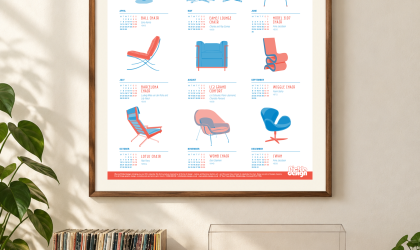
Full calendar

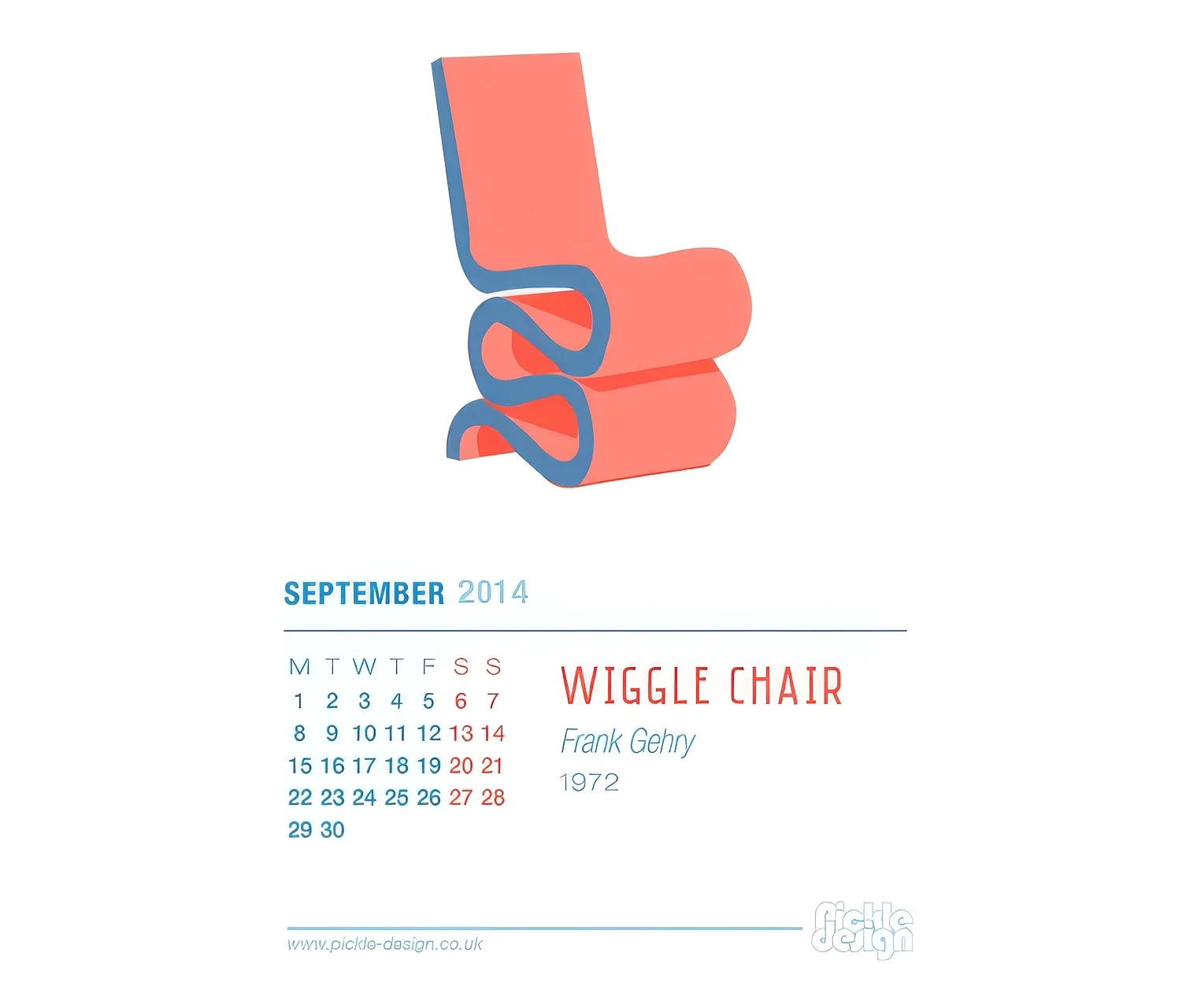
There can’t be many pieces of furniture that make corrugated cardboard look quite this sophisticated. Frank Gehry’s Wiggle Side Chair manages it rather brilliantly.
We originally illustrated the chair for September in our 2014 Pickle calendar, a year devoted to classic chair design. It was an obvious candidate. The looping profile is instantly recognisable, the material is wonderfully unexpected and, more than 50 years after it was designed, it still looks remarkably fresh.
Cardboard furniture wasn’t a completely new idea when Gehry began experimenting with it. During the 1960s designers had already explored ways of folding, slotting and reinforcing sheets of cardboard to make lightweight furniture.
Gehry approached the material differently. He was already surrounded by corrugated cardboard because he used it to make architectural models. Rather than treating it as a thin sheet that needed to be folded into strength, he began gluing layers together and cutting into the resulting blocks.
By gluing layers of corrugated cardboard together with the corrugations running in alternating directions, he produced an unexpectedly strong material that he called Edge Board. Suddenly something associated with packing boxes could be carved almost like timber.

Those experiments developed into the Easy Edges furniture series in 1972. Instead of disguising the humble material, Gehry made a feature of it. From the side, the exposed edges reveal layer after layer of corrugation, turning the construction itself into part of the decoration.
The Wiggle Side Chair is the piece that has come to represent the series. Vitra still produces it today, with a structure of corrugated cardboard and hardboard reinforcing the edges. The material sounds flimsy, yet the finished chair is strong, robust and designed to be sat on rather than simply admired.
The design also found its way into museum collections. New York’s Museum of Modern Art has a 1972 Easy Edges Side Chair in its Architecture and Design collection, made from laminated corrugated cardboard and fibreboard.
The material is clever, but it is the silhouette that makes the chair memorable. Seat, back and base seem to flow into one another in a series of exaggerated loops. Viewed from the side it is almost a piece of line drawing made solid.
Those curves aren’t only there for effect. The repeated folds put material where the chair needs support, while that tall back and generous seat make it look considerably more inviting than the words ‘corrugated cardboard chair’ might suggest.

There is also something rather pleasing about the contradiction. Gehry used one of the cheapest and most disposable materials imaginable to make a piece of furniture that has ended up being treated as a design classic. It is playful without being a joke, and experimental without forgetting that somebody eventually has to sit on it.
Gehry is much better known for architecture, but the Wiggle Chair already shows the fascination with material, structure and unexpected forms that became so characteristic of his work.
Perhaps that’s what makes it such a useful design classic too. It isn’t simply an attractive old chair. It changes the way you look at something ordinary. Once somebody has turned packing cardboard into furniture worthy of MoMA, a pile of boxes never looks quite as unpromising again.
The Wiggle Chair first appeared at Pickle as the September illustration in our 2014 calendar of classic chairs. We looked back at the complete collection on Design Debate in Take a Seat, which ranges from Gehry’s cardboard curves to Arne Jacobsen’s Swan Chair.
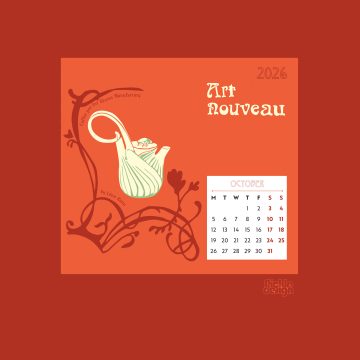
Our obsession with instantly recognisable objects carried on. A later Design Classics collection on Design Debate widened the net beyond furniture, while our 2025 calendar returned to the theme with another year’s worth of objects whose shapes have become part of design history.
And if chairs aren’t enough, the Chesterfield sofa is another fascinating example of a piece of furniture becoming recognisable almost entirely from its silhouette. Its history is considerably murkier than Gehry’s cardboard experiment, but it has proved just as difficult to dislodge from the design world.